Gamification – A powerful method for facilitation
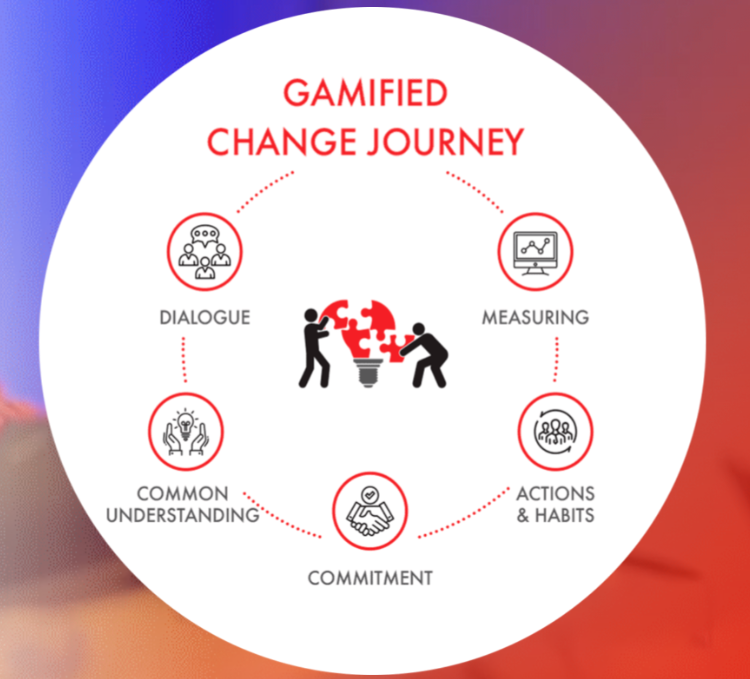
Muutostaito’s Changeskills game format is about to facilitate a group of people discussing the essential questions about a change (in strategy, culture, process, behaviour, etc.), making a plan to implement the change and following up on it.
The foundations of Muutostaito’s game format were laid at the start of the 1990s. The game was developed at the Helsinki University of Technology and, in conjunction with this development work, several academic studies were conducted on how the game could be applied. Unlike many existing board games used for training, an essential feature of this game was that it was not used to teach teamwork. Instead, the questions in the game guided the team towards discussing important matters in terms of the team’s development, as well as working together to resolve and agree upon any matters that arose.
Why Muutostaito’s Changeskills game format works?
The purpose of Muutostaito’s game format is to create a structure in which participants produce interpretations, insights and solutions for pre-designed questions and topics with the help of the game. The discussion that takes place during the game is created by the players themselves and solutions arise through group discussion. The participants bring their own interpretations, tacit knowledge and wealth of experience to bear on the game topic. The participants are motivated to engage in discussion when the topics are directly connected to their own work. The game involves taking a stance on the questions and alternative answers –first in small groups and then in a larger group. The answer alternatives are designed to elicit a range of important perspectives on the question.
- Open atmosphere of mutual trust
The basic philosophy of Changeskills game format is that discussions involve all participants and all viewpoints are valued. This leads to an open atmosphere of mutual trust around the game. Even participants who do not usually engage in training events find it easier to participate because the questions are directly related to their own work and the answers do not allow a ‘possibility of failure’.
- Putting effort into answers and listening to others
A key element of the Changeskills game format is listening to and understanding other teams’ positions. In addition, the teams are required to make joint decisions in a limited time in such a way that a group consensus is reached without voting. The game motivates and encourages players to give reasoning and high-quality answers because the format involves evaluating the other teams’ responses and every team is evaluated in turn. As the format involves evaluating the other teams’ responses, they become more interesting, and listening to other teams’ viewpoints is a very natural part of the workshop that increases the intensity of the game even further.
- A game of feelings
In the Changeskills game format, feelings are mainly created through the dynamics between the players rather than the interaction between the player and the game content. Games based on the Changeskills game format are clearly not entertainment games, but the competitive setting and differing interpretations of questions and words arising during the game create funny moments and the space for humour. The game facilitator’s professional skill enables this dimension to be fine-tuned and, if necessary, the atmosphere to be lifted or the focus to be shifted back towards work.
- Equal dialogue
The game’s structure is instrumental in ensuring that all of the players are equal within the game, regardless of the participants’ roles or positions. Similarly, the game’s structure and schedule contribute to ensuring that all of the planned topics receive the planned amount of time for discussion and that socially active personalities do not dominate the discussion.
- Right questions are essential
The formulation and selection of questions is the most important aspect in terms of the game’s results. The game should guide the discussion in the intended direction and give rise to a clear need to change the status quo to head towards the target. When selecting subject areas, it is important to ensure that the game features questions which are important to all of the participants and which as many participants as possible can influence through their own work.
The game format itself encourages players to understand differences and varying viewpoints and tolerate different interpretations of the same matter. In this regard, the facilitator aims to ensure that the game does not get bogged down in semantic or linguistic details, and that the focus of discussion is practical action rather than theoretical differences of opinion.
Please find more information and read more about us:
https://www.muutostaito.fi/en/front-page/